Last friday I went to London to visiting the Google office with other GSoCers.First of all, I went to London to visit Google and I had no idea how great it would be to met other GSoCers. Everybody were nice, funny and very excited about theirs projects.
We had a nice lunch (with sushis, I love sushis !!!) and we had a round table with Chris Di Bona and Zaheda Bhorat where everyone did an self-introduction. It was a chance to know a little bit more about everybody and it also was a chance to see in what kind of studies we're all involved. Then we did the lightning talk presentations and we had a big chat about the Google Summer of Code: what was great, what went wrong, what is next, what could be improved etc.
A Googler came to talk to us about being an engineer at Google and we did a visit of the Office.
It was very enriching at so many level. I learned more about the Google work environment, what kind of relationship Google has with the Open source world, how awesome GSoCers are and it was also a great opportunity to know more about being an engineers at Google.
You can get the pdf version here.
Sunday, October 29, 2006

Tuesday, October 3, 2006
Visualize the parse tree of a PHP source code
wrote this xslt stylesheet to visualize the parse tree of a PHP source code.
The stylesheet can actually convert any XML tree to a graph in the dot format interpreted by Graphviz.
The code to vizualize nice parse tree with the PECL extension is the following:
 To test this example at home, you need the Parse Tree pecl extension, an xslt proc and graphviz:
order.php is the original php file.
order.xml is the xml generated with the parse_tree_from_file function.
order.dot is the parse tree in dot format.
order.png is the png generated by graphviz.
toDot.xsl isthe stylesheet generating dot from xml.
The stylesheet can actually convert any XML tree to a graph in the dot format interpreted by Graphviz.
The code to vizualize nice parse tree with the PECL extension is the following:
//Loading the parse tree into a DOMDocument
$xml = new DOMDocument;
$xml->loadXML(parse_tree_from_file('order.php'), XML_OPTIONS);
//Loading the stylesheet into a DOMDocument
$xsl = new DOMDocument;
$xsl->load('toDot.xsl', XML_OPTIONS);
//Stylesheet processing
$proc = new XSLTProcessor;
$proc->importStyleSheet($xsl);
//Generating the image with graphviz
file_put_contents('order.dot', trim($proc->transformToXML($xml)));
`dot -T png -o order.png order.dot`
So if order.php contains the following source code:class Order{
private $items = array();
private $amount = 0;
public function addItem($reference, $quantity){
$this->items[] = array($reference, $quantity);
$this->amount += $quantity*Catalog::getPrice($reference);
}
public function getAmount(){
return $this->amount;
}
}
class Catalog{
private static $priceList = array('Largo Winch' => 9.31, 'Astérix' => 8.46, 'XIII' => 8.70);
public static function getPrice($reference){
return self::$priceList[$reference];
}
}
$myOrder = new Order;
$myOrder->addItem('Largo Winch',2);
$myOrder->addItem('Astérix',2);You'll get the following tree: To test this example at home, you need the Parse Tree pecl extension, an xslt proc and graphviz:
order.php is the original php file.
order.xml is the xml generated with the parse_tree_from_file function.
order.dot is the parse tree in dot format.
order.png is the png generated by graphviz.
toDot.xsl isthe stylesheet generating dot from xml.
Thursday, September 28, 2006
A Logo for phpAspect.

Fabien is also a student at Telecom Lille and he does freelance work in design and graphics.
So if you need any work done in this field, don't hesitate to hire his talents ;-)
Thank you, Fabien!
Thursday, August 31, 2006
phpAspect presented at the EPFL
Last week I was invited by Christelle Vangenot to talk about phpAspect with Philippe Rochat and some of the new features I developed during the Google Summer of code.
The slides are availables at this address: http://phpaspect.org/conferences/poa_epfl.pdf
I'll make a futher post on this blog to talk about the end of the Google soc and the new version of phpAspect which should be released soon.
The slides are availables at this address: http://phpaspect.org/conferences/poa_epfl.pdf
I'll make a futher post on this blog to talk about the end of the Google soc and the new version of phpAspect which should be released soon.
Tuesday, June 20, 2006
PHP source code analysis: PHPCompiler versus Yaxx
The original PHP compiler doesn’t use AST representation of a source code so in the previous versions of phpAspect I had to fill the php grammar with my own AST constructions. It was a painful job and moreover I had to do it in each major version of PHP. For this new version, I'm using the yaxx project written by Dr. Yijun Yu. The yaxx tool is a yacc skeleton which build an xml ast representation of a source code according to his grammar.
For example, the following php source code:

We will obtain the following Tree (with the php lexer & grammar in input):
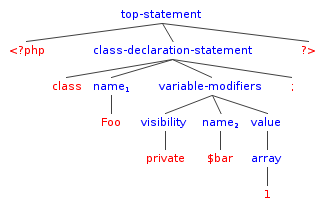
Using this compiler structure, the common visitors of a traditional compiler becomes xslt style sheet. A toEval visitor becomes a toEval xslt style sheet etc... I already wrote a very simple toWrite visitor which just take care of writing the text into tokens.
The hardest part is now to perform weaving using xslt and the main limitation is that xslt variables are constants.
I keep you in touch ;o)
For example, the following php source code:

We will obtain the following Tree (with the php lexer & grammar in input):

Using this compiler structure, the common visitors of a traditional compiler becomes xslt style sheet. A toEval visitor becomes a toEval xslt style sheet etc... I already wrote a very simple toWrite visitor which just take care of writing the text into tokens.
The hardest part is now to perform weaving using xslt and the main limitation is that xslt variables are constants.
I keep you in touch ;o)
Friday, June 16, 2006
Gregor Kiczales @ Google
I found on Google Video an very interesting conference about AOP given by Gregor Kiczales himself at Google.
Link for the video: http://video.google.com/videoplay?docid=8566923311315412414
For those which do not know Gregor Kiczales, he is one of the major founder of aspect-oriented programming
Popout
Link for the video: http://video.google.com/videoplay?docid=8566923311315412414
For those which do not know Gregor Kiczales, he is one of the major founder of aspect-oriented programming
Popout
Thursday, June 8, 2006
Using XML Representations of a PHP parse Tree
The original PHP compiler doesn’t use AST representation of a source code so in the previous versions of phpAspect I had to fill the php grammar with my own AST constructions. It was a painful job and moreover I had to do it in each major version of PHP. For this new version, I'm using the yaxx project written by Dr. Yijun Yu. The yaxx tool is a yacc skeleton which build an xml ast representation of a source code according to his grammar.
For example, the following php source code:
We will obtain the following Tree (with the php lexer & grammar in input):
Using this compiler structure, the common visitors of a traditional compiler becomes xslt style sheet. A toEval visitor becomes a toEval xslt style sheet etc... I already wrote a very simple toWrite visitor which just take care of writing the text into tokens.
The hardest part is now to perform weaving using xslt and the main limitation is that xslt variables are constants.
I keep you in touch ;o)
For example, the following php source code:
We will obtain the following Tree (with the php lexer & grammar in input):
Using this compiler structure, the common visitors of a traditional compiler becomes xslt style sheet. A toEval visitor becomes a toEval xslt style sheet etc... I already wrote a very simple toWrite visitor which just take care of writing the text into tokens.
The hardest part is now to perform weaving using xslt and the main limitation is that xslt variables are constants.
I keep you in touch ;o)
Subscribe to:
Posts (Atom)